Guide
What a battery install finds in an older Parramatta switchboard
Published 4 September 2026 · 8 minute read
Most of the surprises on a battery job are not about the battery. They are about the board it gets wired into, and on a house built before 1980 that board has usually had a long and undocumented life.
This is what actually happens, why it happens now rather than thirty years ago, and how to make sure it appears on your quote instead of your invoice.
The short version
- A battery does not break your switchboard. Connecting it brings the affected circuits up to the current standard, and that is what finds things.
- A crossed or shared neutral is the classic find. Old fuses never measured for it, modern safety switches do.
- The repair is usually cheap. Locating the fault is the expensive part, and on a much extended house it can take hours.
- Post-war brick with a back extension is the highest risk profile in our area. 1990s and newer stock is usually fine.
- Ask whether a board upgrade is in the price or excluded, and how fault finding is charged. Get both in writing.
- The NSW Home Energy Saver loan lists switchboard upgrades as an eligible upgrade in their own right.
01
Why a battery ends up touching the switchboard
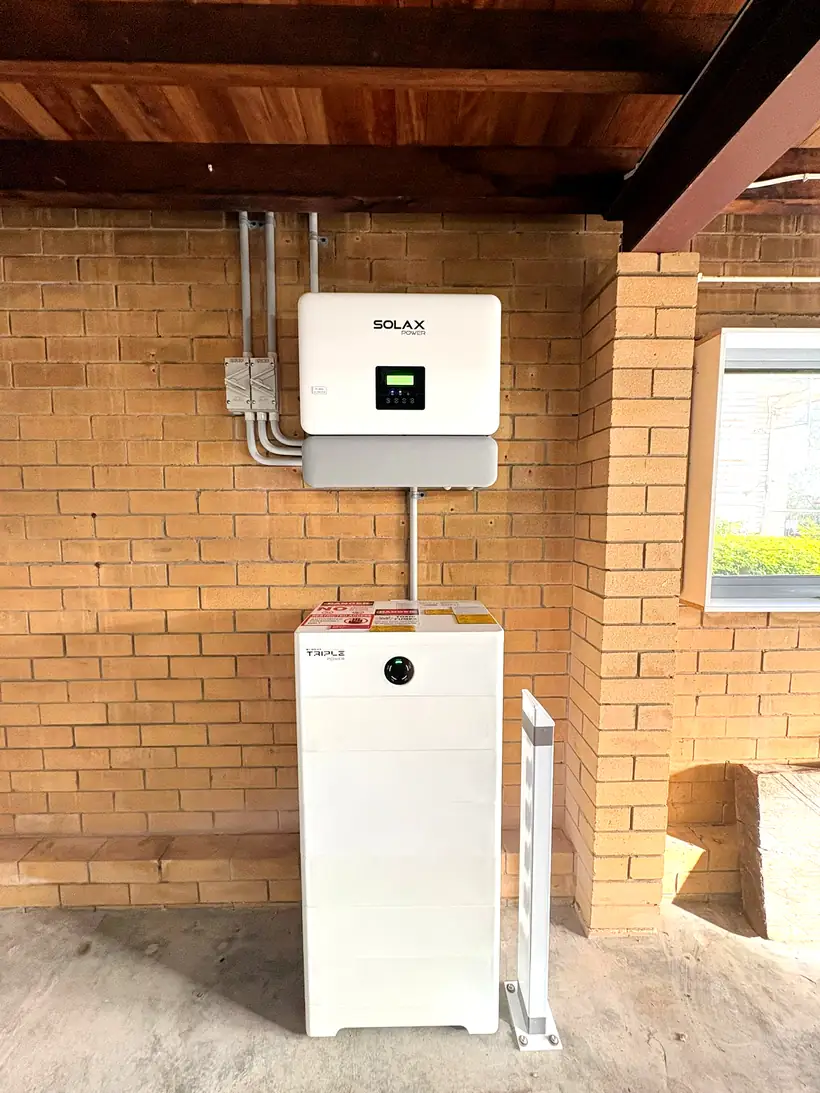
A battery is not an appliance you plug in. It is a piece of generating and switching equipment that gets wired into the same board that runs your lights, your oven and your hot water, and the electrical work that connects it is what brings the board into scope.
Once a sparky modifies part of an installation, the parts affected by that work have to meet the standard that applies now, not the one that applied when the house was built. That is the whole mechanism. The battery does not fail your switchboard. The rules that come with connecting it do.
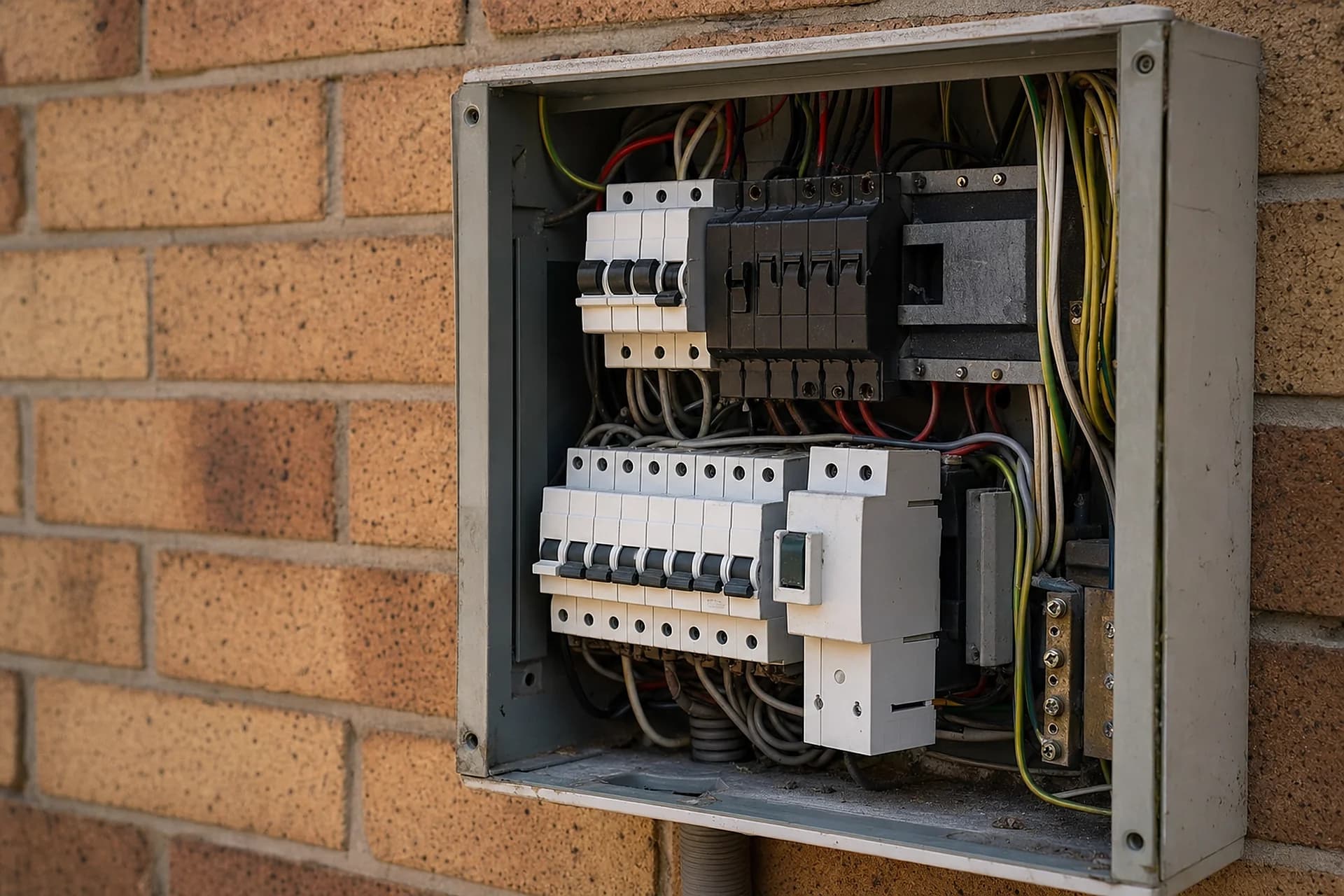
On a board that was assembled in the 1960s and quietly extended three times since, that can mean new protective devices, more space than the enclosure has, or a rearrangement of circuits that were never separated properly in the first place.
02
The crossed neutral, and why it waited thirty years to appear
Every circuit has an active conductor carrying power out and a neutral bringing it back. A modern safety switch, an RCD or an RCBO, watches both and compares them. What goes out should come back.
When it does not balance, the device cuts the circuit, because an imbalance means current is returning somewhere it should not be. That is the device doing exactly its job.
So where does the imbalance come from
A crossed or shared neutral is a circuit whose return path runs back through a different circuit. Older wiring did this deliberately in places, and renovations did it accidentally in many more.
- A back extension wired years after the original house, by a different sparky
- A carport, shed or granny flat added onto an existing circuit
- Circuits split or joined during a kitchen or bathroom job
- Outdoor lighting run off whatever was closest
- A room converted from a garage, with no drawing left behind
None of that trips an old ceramic fuse or a 1970s breaker, because neither device was ever measuring balance. Fit modern protection to those circuits and the fault becomes visible on the first day, usually as one particular light or one particular appliance that drops the safety switch every time.
The upgrade did not create the fault. It ended thirty years of the fault going unnoticed.
03
Why finding it costs more than fixing it
Repairing a crossed neutral is usually a small job. Locating it is the expensive part, because the wrong connection can be anywhere along the circuit and there is no test that points at a spot on a wall.
An electrician works through the likely places in order, and on a house with layers of history there are a lot of them.
- The ceiling space, junction box by junction box
- Light fittings and switches on the affected circuit
- Power points, including the ones behind furniture nobody has moved since 2009
- Anything added later: outdoor lights, a shed run, a pergola
- The seam where an extension meets the original house, which is where it usually is
Sometimes the honest answer after two hours is that rewiring the circuit outright will cost less than continuing to hunt. That is a legitimate call and a good electrician will put it to you as a choice rather than keep billing.
04
What this looks like on Western Sydney housing stock
The suburbs we work across are not one kind of house, and the odds change street by street.
| What you have | What usually decides it |
|---|---|
| Original post-war brick, never rewired | Board age and space. An upgrade is common enough here that it belongs on the quote as a line, not as a discovery. |
| Post-war brick with a back extension | The extension is where a shared neutral most often sits. Worth flagging at the assessment so it is priced as a possibility. |
| Fibro, part rewired over the years | Mixed generations of wiring on one board. Fault finding here is the slowest, because there is rarely any documentation. |
| 1990s and later brick and tile | Usually straightforward. Modern protection is already in and the board has room. |
| Newer townhouse or duplex | Rarely a wiring problem. The constraint is where the meter and the board sit, and whether the roof is yours or common property. |
This is the reason we look at the switchboard at the site assessment rather than quoting from a satellite image. Some of it can be seen from a photograph. The rest cannot be seen until the cover is off, and the honest thing is to say which is which before you accept anything.
05
Five questions that keep this off your final invoice
You do not need to know anything about wiring to protect yourself here. You need five answers in writing.
- Has someone actually looked at my switchboardNot a photo of the front of it. Has somebody opened it, and what did they see.
- Is a switchboard upgrade in this price or notIf it is, it should be its own line. If it is excluded, the quote should say so in words.
- What happens if you find a wiring fault on the dayAsk how fault finding is charged, and at what point you get a call rather than an invoice.
- Who is doing the electrical workA licence number you can search. In New South Wales that is a public register.
- What is the worst case, in dollarsA good installer will give you a range and tell you what would push it to the top of it.
If an installer will not answer the second or the fifth, that is your answer. The number on the front of the quote is not the price of the job.
06
The NSW loan now covers switchboard upgrades
One genuinely useful thing happened in June 2026. The New South Wales Home Energy Saver program lists switchboard upgrades as an eligible upgrade in its own right, alongside rooftop solar, batteries, insulation, reverse cycle air conditioning, ceiling fans and draught proofing.
That matters because the switchboard is the part of a battery project people are least willing to pay for and least able to plan for. A zero interest loan of up to $15,000 is available to households with a combined taxable income of up to $210,000, repayable over ten years. If you are weighing up a battery at all, this is the cheapest the board work is going to be.
We have written the program up separately, including the part that is not open yet. The official program page is where you apply.
Before you book
Common questions
The ones that come up on nearly every first call, answered straight.
Not on the list? Call 1300 958 778 or send it through.
Does every battery install need a switchboard upgrade?
No. Plenty of boards are fine as they are, particularly on houses built from the 1990s onward. What decides it is the age and condition of the board, whether there is physical space in the enclosure, and what protection is already fitted. It is one of the first things we look at during the site assessment, and if it needs work you see the figure before you accept anything.
Can you tell from a photo whether my board needs work?
Partly. A photo of the open board tells us the age of the equipment, roughly what protection is there and whether there is room to add anything, which is enough to say whether an upgrade is likely. What a photo cannot tell us is how the circuits behind it are actually wired, and that is where the surprises live.
My safety switch started tripping after an electrical job. Is that normal?
It is common, and it means the new protection is doing its job on a circuit that was never being watched properly before. It is not something to work around by resetting it repeatedly or by having the device swapped for something less sensitive. It needs a licensed electrician to find the cause.
Who pays if a wiring fault is found during the install?
That depends entirely on what your contract says, which is why it is worth settling before you sign. Ask how fault finding is charged, at what point you get a phone call rather than a bill, and what the likely range is. An installer who will not put a range on it has not thought about it.
Is it worth upgrading the board even without a battery?
If the board still has ceramic fuses or no residual current protection on the circuits that need it, that is a safety question rather than a solar question, and it is worth a conversation with an electrician regardless of what you do about storage. It also removes the largest unknown from any future solar, battery or EV charger job.
More guides
- The solar rebate shrinks every year, and waiting costs you twiceThe federal discount on panels and batteries steps down on a published schedule. What that means for a Parramatta household deciding this year or next.
- The NSW Home Energy Saver, and what it will actually pay forZero interest loans are open, the discounts are not yet. The figures, the income tests, the eligible upgrades and the order you have to apply in.
- Three free hours a day, and what the Solar Sharer offer is worth in ParramattaFree power from 11am to 2pm sounds like a straightforward win. The conditions behind it decide whether it is one for your household.
Find out what your roof is worth.
Send the address and roughly what your quarterly bill runs to. You get a system size, a price and a payback figure in writing, before you commit to anything.